Or: Extraordinary claims require extraordinary evidence. Or: Don’t take for granted claims by people who tell you your whole life has been a lie. There are a number of ways to put this, but whatever take you pick, it will save you from so much nonsense…
Up until I went into my creationism-evolution phase around 2008/2009, I hadn’t had many interactions with conspiracy theories, and I was pretty ignorant on what was out there. Even gullible I guess. Heck I even thought What the bleep do we know?! was a cool movie when I first saw it. I didn’t have the tools or knowledge to fact-check that quantum mechanics stuff, or reason yet to doubt what seemed like a well-made, scientifically grounded movie.
Was I misled my whole life?
That all changed when a fellow student in 2008/2009 challenged my worldview for the first time in a way that sort of made me uncomfortable. Long story short, he told me that radiometric dating was bunk, because living, or recently deceased penguins and seals were being carbon-dated as thousands of years old.
I did not have an answer to that claim there and then. I hadn’t heard of it before. I had never had any reason to mistrust or doubt the consensus of 4.5 billion years I was taught in school. But this argument made me question all of it. What if he WAS right? Holy shit! Everything I thought I knew could be wrong!
Of course in hindsight, this was a textbook example of an extraordinary claim backed up with no evidence (yet). I have always been an eager learner and I want to understand things, so I started researching. For the specific claim made, the answer to the riddle was that aquatic animals can appear artificially old with carbon dating because they incorporate “old” carbon from dissolved sources in water -the reservoir effect. The old dates were anomalous, but for a good and understood reason. And the argument that they showed dating methods do not work was nonsense. My worldview stayed intact.
Verify
The point here is simple. Many people and conspiracy theories will claim we are all asleep. But the truth is out there. You just need to wake up. And they will make grandiose claims to support their positions. Whether that is on how one religion is right, or how a government did or is hiding x/y/z, how vaccines actually kill you, how the earth is flat, or how quantum mechanics shows free energy is real. The best course of action:
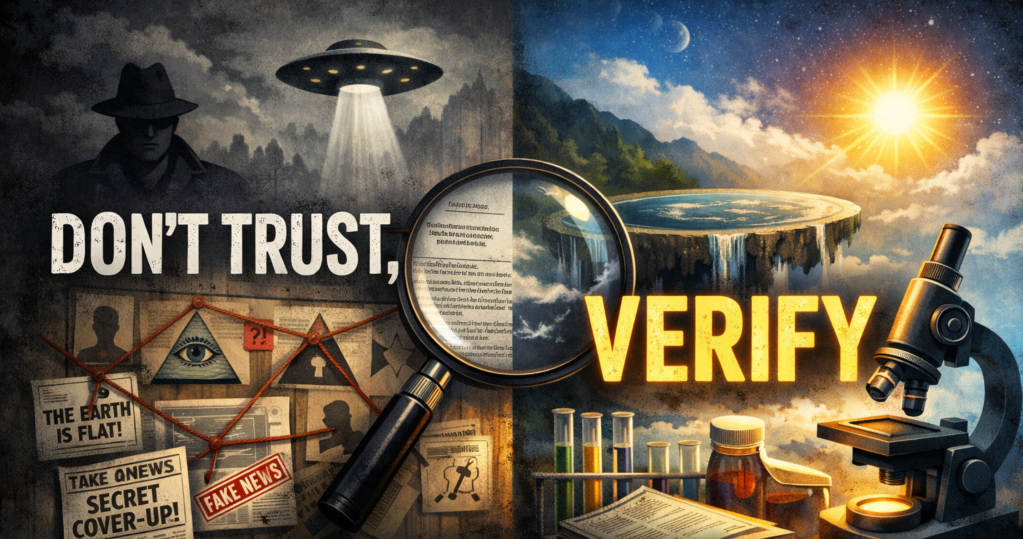
Don’t trust, verify.
Look up sources. Use Google, use ChatGPT. This is your best option when the claim affects your beliefs, your worldview, or your understanding of reality. For me, this approach has guided almost everything I’ve learned since that 2008/2009 conversation.
Alternatively, if the claim has little impact on you, or you are not invested in the subject, or you already know enough to recognize it as false, just move on. The only advice I would add there is to remain open to being challenged in general.
Should you always ‘not trust’ a statement? Not necessarily. An expert or reliable source with proven track records can be trusted more easily and with less risk, especially if claims are modest and well-supported. In certain areas, like conspiracy theories, topics prone to propaganda, or highly polarized topics, this becomes vital. Bottom-line it is the evidence that matters. Always.
I guess in the end I did wake up. Just not to hidden truths or grand conspiracies, but to how easily people (including myself) can be made to believe and spread things that are simply untrue if they stop checking claims for evidence.
 SignalLessNoise