
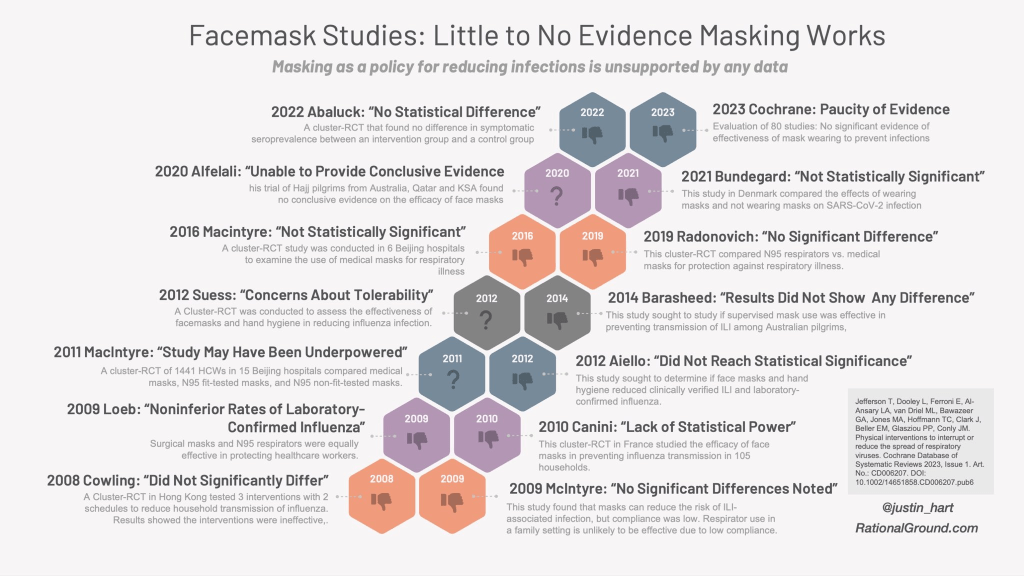
If you need dishonest arguments to make your point, the point is probably bullshit. That’s a very simple rule to live by which will spare you so much nonsense. This visual seemingly depicting how useless masks are according to many studies is a great example.
The question with these type of visuals is very simple: Do the claims attributed to the studies match the actual studies themselves? And if I find that the very first study I check actually says the polar opposite of what you claim, I will stop reading and assume you’re acting in bad faith or simply have no clue what you are talking about. Because if what you’re saying is true you wouldn’t need dishonesty, and you certainly wouldn’t put it on top in your visual.
Computer says no
The first paper I checked was the 2022 Abaluck et al paper[1], which this visual states showed “no statistical difference” between wearing and not wearing masks. But the paper says the complete opposite. It showed roughly a 10% reduction in Covid symptoms and ‘symptomatic seropositivity’ overall, and a massive 35% reduction in age group >60 when people actually wore masks in significant numbers. No difference? Masks work mechanistically, that is the plain truth.
The problem this study, like many others, ran into was that mask effectiveness is not just a mechanistic question but also depends significantly on how many people actually wear masks. If you study mask effectiveness but nobody wears masks, then yeah, you are not going to see significant results. But that can hardly be used as an argument against mask effectiveness.
The Cochrane study[2] on top of the visual suffers from exactly this. Its results were inconclusive, but mainly due to mask adherence being low in the studies they looked at, a point later clarified by the authors as the study’s results were hijacked by the anti-mask crowd, stating:
“Many commentators have claimed that a recently-updated Cochrane Review shows that ‘masks don’t work’, which is an inaccurate and misleading interpretation.”
and:
“The high risk of bias in the trials, variation in outcome measurement, and relatively low adherence with the interventions during the studies hampers drawing firm conclusions.”
In conclusion
Overall, virtually every study cited has a different conclusion, or important nuances are deceptively omitted from the visual. It wants to convey the message that masks are ineffective, while most studies say the opposite or are insufficient to draw that conlusion.
Again, if you need dishonest visuals to convey your message, I’m not going to trust your message…

[1] Abaluck J et al. Impact of community masking on COVID-19: A cluster-randomized trial in Bangladesh. Science. 2022 Jan 14;375(6577):eabi9069. doi: 10.1126/science.abi9069. Epub 2022 Jan 14. PMID: 34855513; PMCID: PMC9036942.
[2] Jefferson T, Dooley L, Ferroni E, Al-Ansary LA, van Driel ML, Bawazeer GA, Jones MA, Hoffmann TC, Clark J, Beller EM, Glasziou PP, Conly JM. Physical interventions to interrupt or reduce the spread of respiratory viruses. Cochrane Database of Systematic Reviews 2023, Issue 1. Art. No.: CD006207. DOI: 10.1002/14651858.CD006207.pub6.
 SignalLessNoise